
TSA - Tactile Sensation Analyzer

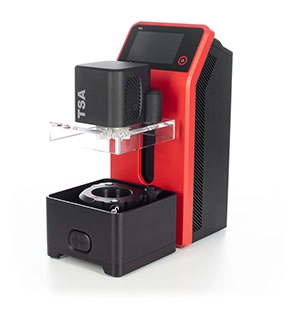
The new emtec TSA Tactile Sensation Analyzer for textile application not only features a high-quality design, but also convinces with extended possibilities for determining haptic comfort. Additionally, the device captures a high-resolution picture of the sample and can be connected to the cloud-based Virtual Haptic Library.

The TSA measuring instrument and measuring method are internationally patented and protected.


Product description

The new TSA measures - like its previous model - the softness, smoothness and flexibility of base and finished products objectively and reliably. Moreover, specific hand feel values (HF) can be calculated from these parameters using mathematical models.

A fundamentally improved capability of determining the sample's springback behavior has been added to the new device. Furthermore, the new TSA offers the possibility to measure two additional parameters: thermal haptics (surface thermal conductivity) and thermal insulation. A camera can take a high-resolution image of the clamped sample in order to give the user a visual impression of the material and to carry out further analyses.

All of this data is automatically digitized and can be processed and stored according to customer-specific requirements through a cloud-based haptic database, the Virtual Haptic Library, making it available to authorized persons worldwide in real-time (quality assurance and control). Additionally, this Virtual Haptic Library enables a search for suitable fabrics worldwide, cataloged according to haptic properties.


Users

Chemical suppliers
Textile producers
Textile converters
Machine builders for textile industry
Universities & Institutes
Retailers
Fiber manufacturers
Fashion labels

Application areas

Process optimization
Process control
Production control
Product optimization
Benchmarking
R&D
Incoming control
Quality assurance
Complaint management
Troubleshooting
Marketing & Sales

Results

Surface Smoothness

Surface Smoothness is the absence of significant texture or deviations from an ideal surface, indicating minimal peaks and valleys (macro structures on the surface). In technical contexts, it refers to a surface with minor irregularities. The surface smoothness affects performance, appearance, and functionality.

Surface Softness

Surface Softness refers to the tactile sensation of a material's surface, determined by its physical characteristics like micro-surface variations and micro-compressibility (surface compressibility) when touched with fingertips. It is distinct from bulk softness, which involves the material's overall pliability when crumpled or folded.

Stretch & Recovery

The "Stretch" of a textile refers to its ability to be pulled or elongated in size.

The "Recovery Behavior" of a textile refers to its ability to return to its original shape and dimensions after being pulled or elongated in size. Three different parameters determine the recovery behavior of a textile fabric: the hysteresis, the plasticity (recovery), the elasticity.
Hand Feel Value

The emtec TSA objectively measures the three basic parameters which determine the human hand feeling: micro-surface variations (feeling of softness), the macro-surface variations (feeling of smoothness) and the flexibility (in-plane stiffness) of any kind of textile material. By the help of special algorithms, these single parameters can be combined to the so-called Hand Feel (HF) Value. With the right mathematical model, a correlation to the human expectation of up to almost 100 percent is possible.

Crumple Resistance

Crumple Resistance in textiles is the fabric's ability to resist a load that is applied to deform it; e.g., consumers in the store grabbing into a garment.

Thermo Haptic

How warm or cool does a fabric feel on the surface defines Thermo Haptic.

Thermal Insulation

Thermal Insulation is a material's ability to restrict the transfer of heat, keeping the body warm in cold environments or preventing heat from entering in hot ones by trapping air within its fibers and structure.

Compressibilty

Compressibility is the ability of a material to reduce its thickness or volume when subjected to an external pressure, a property that is crucial for a comfort and overall "handle" or feel. The compressibility of a textile is directly linked to its internal structure. For instance, loose fiber masses and woven fabrics with an intricate arrangement of fibers show different compressibility behaviors.

Air Permeability

Air Permeability measures the ease with which air passes through a fabric, indicating its "breathability". It's determined by testing how much air flows through a fabric under specific pressure and time conditions. This property is crucial for various applications, including sportswear for moisture regulation, medical textiles for patient comfort, and technical textiles like filter fabrics and parachutes for their performance.

Camera Shot

High-resolution image from the sample.


Technical data

device dimensions

40,3 x 18,0 x 35,5 cm (H x W x D)

device weight

15 kg

power supply

100-240 V AC, 50/60 Hz

standard sample dimension

112,8 mm = 100 cm² (round circle)

Videos


Success Stories & Scientific Studies